The Conversation That Spikes Your Heart Rate
Give me a leader who asks one good question over one who gives a fast answer any day.
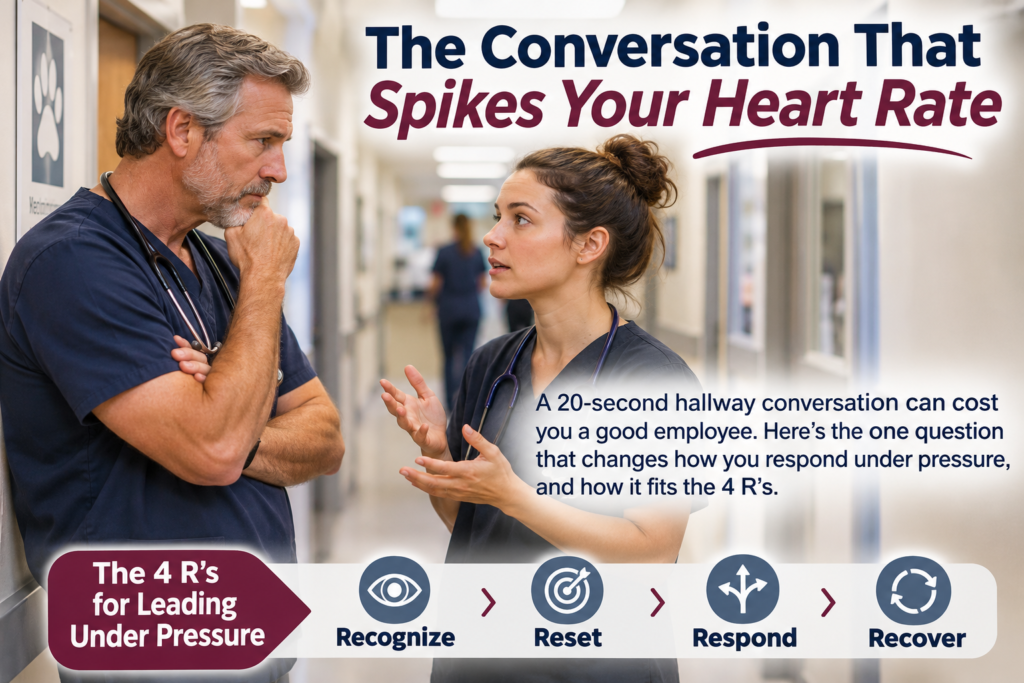
It’s 4:45 on a Thursday. You’ve been on your feet since seven. Your newest associate, 26 and good with clients, catches you in the hallway.
“Could I start at nine on Fridays instead of eight?”
You feel it before you think it. Your jaw sets. Your chest gets tight. And before she’s finished the sentence, the answer is already on its way out:
“When I started, we didn’t get to pick our hours.”
She nods. Says okay. Walks away.
The conversation took 20 seconds. What it cost will take a lot longer to show up.
Behaviour is downstream
That hallway moment didn’t start with your words. It started further up.
- Pressure creates a thought. A long day, a full schedule, and a request you didn’t expect. The thought shows up fast: no work ethic.
- The thought creates a feeling. Annoyed. Maybe a little disrespected.
- The feeling drives behaviour. A short answer and a lecture about how it used to be.
- The behaviour creates a result. She stops bringing you ideas. A few months later, her resume is out.
- Repeated results become identity. After the third or fourth time, you start believing something about yourself: I just can’t manage young people.
Most leaders try to fix this at step three. Be nicer. Count to ten. Watch your tone.
But behaviour is downstream. By the time you’re working on your tone, the thought and the feeling have already done their work.
The real work happens upstream, in the first few seconds. The 10-second window comes from the Pressure-Free Method by Elle Ingalls, and I’m certified in it. From a resting heart rate, it takes about ten seconds for your body to start releasing stress hormones. Catch the pressure inside that window, and you get to choose what happens next.
The question that changes the conversation
I’ve been listening to Tim Elmore’s A New Kind of Diversity. He points out that for the first time, up to five generations are working on the same team. People who grew up in different worlds bring different rulebooks to work. Most of the friction isn’t about character. It’s about rulebooks nobody said out loud.
Elmore offers a simple question I now use with every leader I coach. When something rubs you the wrong way, ask:
Is this a preference, an expectation or a requirement?
A preference is how you like it done. An expectation is something you assumed but may never have said. A requirement is a value you won’t bend on. Conflict usually starts when a preference gets treated like a requirement.
Starting at eight on Fridays might be a requirement. Surgery starts at 8:15 and you need her there. Or it might just be how you’ve always done it. You can’t respond well until you know which one it is.
Here’s how that question fits into the 4 R’s.
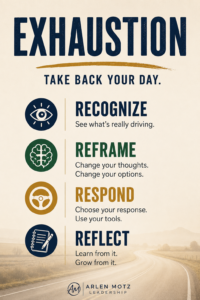
- RECOGNIZE with curiosity. Notice the jaw, the tight chest, the urge to explain how it used to be. That’s pressure, not proof. That’s your 10-second window.
- REFRAME with intentionality. Ask the question. Preference, expectation or requirement? Separate the facts from the story you’re telling about her generation.
- RESPOND with consistency. Start with what you agree on. Say what you believe is happening. Ask how she’d make it work. Hold the requirement. Flex on the preference.
- REFLECT with trust. Afterward, ask yourself which of your rulebooks showed up, and what she taught you. Every moment has something to teach you.
Run the hallway again with the 4 R’s:
“I want to make that work if we can. Fridays are heavy, and I need someone in for the 8:15 surgery. If we can cover that, I’m open to it. How would you set it up?”
Same owner. Same standard. Very different result.
It follows you home
That same spike doesn’t stay at the clinic.
It shows up at the supper table when your 16-year-old wants to skip the family thing for a friend’s plan. It shows up when your kid answers a question with a text from the next room. Same jaw. Same tight chest. Same answer already on its way out.
Listening to a young associate and listening to your teenager is the same skill. How you respond shapes how much they trust you with the next conversation.
Here’s what too many leaders overlook.
You can hire good people. You can write a clear policy. You can build a schedule that works on paper.
But if the conversation spikes your heart rate and you answer from that spike, the people closest to you only experience your pressure. Not your care.
Your team doesn’t experience your stress. They experience your response.
Pressure is inevitable. Response is a choice.
Find out how you respond under pressure. The Leadership Under Pressure Assessment takes five minutes and scores you on all four R’s: Take the free Assessment
Arlen Motz,
Founder & Lead Executive Coach, AM Leadership
Resources:
Tim Elmore’s A New Kind of Diversity
Views 103